Tuesday, February 20, 2007

Mr. Chairman, tell me about those more than 50 tests, please.

Of course, these entries are brief, however, a total disclosure of the facts would be quite lengthy. Anyway during the past eight years or so, I've submitted several Petitions for Rulemaking to the NRC and they have all been denied. But the record is there, including letters of derision from various vendors, operators and lobbyists. (More on all that in future entries to this blog.)

In the early 1970's there was a lengthy set of hearings run by the AEC in the matter of emergency core cooling systems. About the best assertion by the Commissioners is that more tests with Zircaloy are necessary to "... overcome the impression left from run 9573."

One of my petitions was docketed as PRM-50-76 and the NRC spent a few dollars on a document of refutation, ML041210109, April 29, 2004.

The following is extracted from that document:

Mr. Leyse states that:

"Petitioner is aware that more experiments with Zircaloy cladding have not been conducted on the scale necessary to ... overcome the impression left from run 9573."

In the early 1980's, the NRC through Pacific Northwest Laboratories (PNL) contracted with National Research Universal (NRU) at Chalk River, Canada to run a series of LOCA tests in the NRU reactor. More than 50 tests were conducted to evaluate the thermal-hydraulic and mechanical deformation behavior of a full length 32-rod bundle during the heatup, reflood and quench phases of a large break LOCA. ... The NRC is reviewing the data from this program to determine the value of using it to assess the current generation of codes such as TRAC-M, now renamed TRACE.

Well, it has been almost three years since our NRC issued that analysis, but I have yet to find documentation of those more than 50 tests from the early 1980's. Moreover, there is no reference to those "... more than 50 tests ..." in the great "Compendium of ECCS Research for Realistic LOCA Analysis," NUREG 1230, December, 1988. And, if the NRC has ever gotten around to determining the value of whatever meager data may exist, they have likely found that it has no value although they have not openly documented that.

Repeating, the NRC staff issued its document of refutation, ML041210109 on April 29, 2004. Almost one year later, the NRC notified me of its denial of petition for rulemaking (PRM-50-76). In her cover letter, (ML052220454), the Secretary of the Commission, Annette L. Vietti-Cook, a designated authority in these matters, informed me:

Contrary to your assertion that there has not been appropriate testing to address the issues raised by run 9573, the NRC has continued to study complex thermal hydraulic effects on ECCS heat transfer processes during accident conditions related to LOCAs consistent with Commission direction. As part of that initiative, the NRC funded more than 50 Zircaloy clad nuclear fueled bundle reflood experiments at the National Research Universal (NRU)reactor. These experiments evaluated fuel rod and heat transfer behavior but did not include metallurgical examination to evaluate oxidation behavior. The NRC is continuing to conduct and evaluate experimental and analytical programs on fuel cladding behavior.

Maybe the Secretary is using tricky language. She says the NRC funded more than 50 tests, but in contrast to the report of her staff, she does not assert that more than 50 tests were conducted. In any case, there are no more than 50 tests in any record, and the NRC is practicing fraud and falsification.

Bernie Ebbers of Worldcom fame disclosed that he knew what he did not know and that he knew nothing about technology or financial accounting. He is in jail and will likely be there for for a long time!

Monday, February 12, 2007

Regulation by myth

Here are quotes from NRC's inspection report for River Bend, ML060600503, February 28, 2006:

General Electric (the fuel vendor) calculated that the cladding surface temperatures exceeded 1200 F in localized areas.

and

The team noted that the thermal resistance of crud is not normally sufficient to cause cladding temperature increases consistent with those observed during Cycle 8. In most circumstances, "wick boiling" occurs within the crud. That is, capillary coolant channels within the crud deliver coolant to the cladding surface. Steam then escapes from the cladding surface in chimney type plumes. This is a fairly effective method of heat transfer. However, in some instances the capillary coolant channels can become clogged, creating a static steam blanket on the cladding surface. Steam is an exceptionally good thermal insulator. This is the process that caused the very high cladding surface temperatures and ultimately resulted in fuel cladding failure.

Now, "wick boiling" is a fabrication from somewhere, and the above quote is a myth. So, I sent an e-mail to Chairman NRC advising him to get that paragraph eliminated. I e-mailed, "Indeed that entire paragraph should be deleted in a corrected report. The team should study report ANL 6136."

I should also have told the Chairman to have the inspection team study McAdams, Heat Transmission, 1942, Chapter X, HEAT TRANSFER TO BOILING LIQUIDS. On page 316, "The small amount of scale necessary to reduce a high coefficient by a substantial amount is not generally realized."

Maybe the NRC thinks that crud is not scale!


Saturday, February 10, 2007

"... continued operating risks were accepted ..."

Please see my entry of February 5, 2007, WHOOPS! A Clue to Fouling Elsewhere?

The title, "... continued operating risks were accepted," is extracted from the first of the two Oxenford papers. My contention is that the "operating risks" are safety risks. At least one "expert" has testified to the NRC's ACRS that severe fouling is not a safety matter; that severe fouling is merely an economic consideration. That testimony was presented a few years prior to the Oxenford papers. A skilled sanitizer from the nuclear power lobby would have changed Oxenford's "operating" to "economic."

Now, the above cited "expert" was (or is) not out of line with NRC thinking. In the enclosure with her letter to Entergy's Hinnenkamp on February 28, 2006, the NRC's Linda Joy Smith reports that her inspection team at River Bend found that crud during cycles 8 and 11, "... is of very low safety significance ... ." See NRC file ML060600503. I'll report further on this.

Monday, February 5, 2007

WHOOPS! A Clue to Fouling Elsewhere?

Washington Public Power Supply System (WPPSS) changed its name to Energy Northwest. Apparently this populist-controlled enterprise thus sought to escape its reputation that was characterized by WHOOPS! following the default of a few $billions of its bonds. So, I was very surprised to run across one of the best disclosures of fouling through the ages sitting in plain view of the public right there on the populists' web site. Now, I did not initially find the following on that web site. And I also found out that the documents had never been submitted to the NRC. In fact, I am the person who submitted this information to the NRC and thus arranged to get the Oxenford reports into the NRC's Public Document Room via my e-mail to Chairman, NRC on September 19, 2006, see NRC file ML062650095. So, please study the following extraction and my further analyses.

The above report is a fantastic disclosure, and I will be pleased to be corrected, but all of this seems to have gone on without any attention from our NRC.


The above view is from the Oxenford report page 13. It is very interesting that this 1999 data is first released 6 or 7 years later, and it is the first time anyone has openly disclosed that main condenser inleakage may be among the root causes of fouling.
The above slide from Oxenford, page 16, is explicitly labelled, "After Chronic Condenser Leak." On page 4 of his June, 2006, white paper, Oxenford discloses, "Our concerns resurfaced in 1999 following fuel failures at the River Bend plant (admiralty brass condenser with deep bed demineralizers). We closely tracked the River Bend cause analysis. River Bend corrosion had high copper levels, but the failures were attributed to high iron levels in their corrosion layer. Based on Columbia being a low iron plant, no action was taken."
Although Columbia was allowed to track the fouling investigations at River Bend during 1999, River Bend issued a voluntary Licensing Event Report on March 1, 2000, as noted below. River Bend made it very clear that it was issuing the LER only as a voluntary activity. Indeed, subsequent severe fouling at River Bend was not reported as an LER and only came to light in presentations to technical societies and outside of the purview of NRC.
Readers may find the River Bend LER on the NRC web site as directed below. The LER is somewhat misleading, there is a lot of fog in the discussion of root cause. Although this River Bend LER refers to fouling and fuel element failures at other plants, there is no disclosure that inleakage via the main condenser was found to be a significant root cause of fouling at the Columbia Generating Station.


Saturday, February 3, 2007

"It is a flame-front phenomenon ... ."

Please click on the
http://www.inl.gov/relap5/rius/yellowstone/leyse.pdf
You will then view a set of 18 slides.

Today I'll discuss slide 16 and then slide 15. Slide 16 is below, followed by slide 15


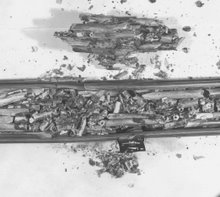
Unfortunately, MacDonald did not present any photographs. If he had, they would very likely be similar to the photograph on my entry of January 21, 2007, in this blog. That test was conducted on December 11, 197o, or more than 10 years before the MacDonald report to the ACRS. The test of December 11, 1970, became known as run 9573. During 1973, the Atomic Energy Commission held a series of hearings as they investigated the safety of nuclear power plants under accident conditions. The Commissioners were dismayed by the implications of run 9573 and the transcript of the proceedings includes the quote below in slide 15.


It is interesting that as of today, over 33 years later, experiments with zircaloy cladding have not overcome the impression left from run 9573. MacDonald's report of the PBF test certainly does not overcome the impression left by run 9573. And the flame front phenomenon described by MacDonald has not been addressed in any of the months or years following his report; however, billion dollar models have been concocted.


Friday, February 2, 2007

Further Notes on ULTRASONIC FUEL CLEANING Under CFR 50.59

Eight Sites Have Applied Ultrasonic Fuel Cleaning
The Westinghouse brochure that is referenced in my entry of January 27, 2007, lists the following eight sites that have applied ultrasonic fuel cleaning by the end of 2005.
  • Callaway
  • Catawba
  • Ft. Calhoun
  • McGuire
  • Quad Cities
  • South Texas 1 and 2
  • Vogtle 1 and 2
  • Vandellos

This Westinghouse brochure was recently updated during November 2006, therefore the list is very likely up to date.

Recent Patent in the Arena of Ultrasonic Fuel Cleaning

The U. S. Patent 7,134,441, HIGH THROUGHPUT ULTRASONIC CLEANER FOR IRRADIATED NUCLEAR FUEL ASSEMBLIES, that issued on October 14, 2006, is assigned to Dominion Engineering, Inc. The related provisional application, No. 60/398,726 was filed on July 29, 2002. Very likely the process changes that are thus covered have been applied in at least some of the eight plants listed above. Also, other process changes may be the subject of further patent applications that might now be under review.

Apparently Ultrasonic Fuel Cleaning Has Not Been Applied at River Bend

It is interesting that River Bend is not among the above list of eight plants in view of the extreme fouling that is documented in my entry of January 22, 2007, Fouling of Reactor Fuel at River Bend. Possibly the corrosion of the reactor fuel at River Bend has been so severe that the ultrasonic process would lead to unacceptable cracking of the cladding.

Thursday, February 1, 2007

A wild application of CFR 50.59, ULTRASONIC FUEL CLEANING

The above slide is from the EPRI slideshow, HISTORICAL HIGHLIGHTS, that first appeared on the web during 2005. The above highlight for 1999 is Ultrasonic Fuel Cleaning. However, the first public disclosure of this activity was likely the "CFR 50.59 SUMMARY REPORT FOR THE CALLAWAY PLANT, that was submitted by Callaway to the NRC on November 14, 2001, item RFR 19637. The NRC file code is ML013540440.
The work proceeded in secrecy and my guess is that it began during 1998 because a provisional patent application, Ser. No. 60/128,391 was already submitted by EPRI on April 8, 1999. About three years later, U. S. Patent 6,396,892 was issued on May 28, 2002, with the assignment of ownership to EPRI.
The NRC has never performed a safety analysis of this equipment and its use. Following the installation and use of the equipment at Callaway and perhaps elsewhere, the NRC and its Advisory Committee Reactor Safeguards (ACRS) were informed that the equipment had been applied at nuclear power plants. The NRC has never licensed the equipment for installation and use. This has been a wild application of CFR 50.59!
The slide below was largely copied from an NRC Inspection Report that was sent to the South Texas Project on January 27, 2003. Clearly, the Inspectors reviewed several documents. However, this does not constitute a Safety Analysis. It is unlikely that any of the four documents have been reviewed and approved by the NRC staff that have input to licensing authorizations. None of the four listed documents are in the NRC's Public Document Room. This is another wild application of CFR 50.59.